Fall 2026 Cinematheque
40 Years of Brother Spike Lee
Filmmaker, writer, producer, and actor Spike Lee has been a part of national consciousness for forty years. His cinematic voice emerged in the 1980s and helped foster a renaissance of Black cinema. Lee’s more than fifty feature films, documentaries, music videos, shorts, and commercials have shaped, defined, and invigorated American visual culture. A central aspect of Lee’s visioning concerns itself with conundrums existing in and represented through Black America.
This cinematheque highlights some of Lee’s most well-known, provocative, and engaging work. Centering on his early work, many of these films make you understand why Black people “wanna holler.” In other words, looking critically via aesthetic, narrative, socio-political, and cultural lenses, we take up his works that address systemic problems endemic to the U.S.—racism, police abuse of power, violence and revolt. We explore Spike Lee’s filmic oeuvre and the nature of late 20th and early 21st century America.
All screenings are on Wednesdays at 7:30 p.m. in White Hall, Room 208. The Cinematheque season runs from September 2 until December 9 and is FREE and open to the public. Presenters will introduce each film and hold post-screening Q&As.
September Screenings
Back to top
September 2, 7:30 p.m.
She's Gotta Have It
Created by Spike Lee
Introduced by Dr. Beretta Smith-Shomade
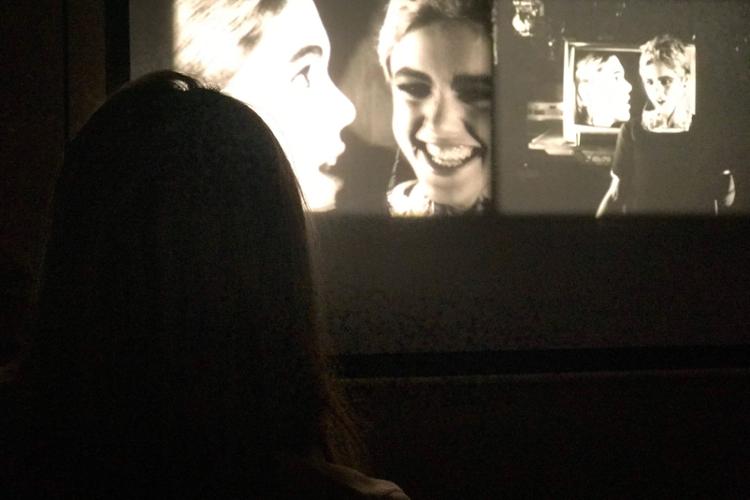
The film She’s Gotta Have It introduces the world to filmmaker Spike Lee. Shot on a budget of $175,000 in 12 days, the film has grossed over $8 million. It opened in New York City on August 8, 1986 with Island Pictures, 40 years ago. Shot in black and white, primarily to keep cost down, it is set in late 1980s Brooklyn and positioned to tell a story of Nola Darling (Tracy Camilla Johns) as an independent and forward-thinking young, Black woman and her concurrent sexual relationships with three different men.
Critics called it “an instant hit” (Black Enterprise), a “surprise smash” (People), and Lee, “the black Woody Allen.” Some film scholars, especially Black feminist ones, have been less laudatory. Cultural critic bell hooks remarked: “The narrators are male, and the story is a male-centered, male-biased patriarchal tale. As such, it is not progressive, nor does it break away from the traditional portrayal of female sexuality in film.”
30 years after its release, Lee reimagines this film as a Netflix series, premiering in the fall of 2017. Reconceptualizing Nola, (now played by DeWanda Wise), he gets to draw a fuller picture of what Nola Darling might be beyond her men. In addition to Wise, the series stars Anthony Ramos, Lyriq Bent, Cleo Anthony, and Ilfenesh Hadera. With this new iteration of the film, we get to see how Lee imagines independent Black women in the 21st century. the 21st century. We will screen three episodes of the first season of the reboot.

September 9, 7:30 p.m.
School Daze
Directed by Spike Lee
Introduced by Dr. Beretta Smith-Shomade and Actor/Dancer Kyme Hersi-Sallid
35mm print provided by UCLA Film and Television Archive.
Coming off the success of She’s Gotta Have It, Spike Lee wrote, directed, produced, and starred in the film School Daze in 1988. The film visualizes life at a fictional, historically Black college, Mission College, one modeled after his alma mater Morehouse College and the other schools of the Atlanta University Center. During this homecoming week, Lee’s musical illuminates concerns being grappled with in 1980s Black collegiate culture surrounding class, color stratification, and pledging at an HBCU. School Daze fosters debates on a multiplicity of fronts. Talking with students at Fisk University, Lee recalls: “The fraternity members were upset about how fraternities were portrayed in the film. We had 90 minutes of heated dialogue” (Los Angeles Sentinel). In a community debate on the film in Chicago, educator Carol Adams expressed that Black folks desire to be accepted by the majority made them afraid to let the world in on “our secret color and class divisions” (Chicago Defender). And writer Toni Cade Bambara notes that within weeks of its release, it became “the subject of extravagant claims by folks who’d seen it and loved it, who’d seen it and not liked it, and who hadn’t checked it out yet but had their ear cocked to Communitysay.” Actor Billy Porter cites School Daze as one of his top three life changing films declaring: “It was us…It was enlarging, my dream territory. I can be on screen?!”
The film stars Laurence Fishburne, Giancarlo Esposito, Tisha Campell, and Kyme Hersi-Sallid. There will be a talk back after the screening with actor Kyme Hersi-Sallid who stars as Rachel in the film.
September 16, 7:30 p.m.
Do the Right Thing
Directed by Spike Lee
Introduced by Dr. Miriam Petty (Northwestern University)
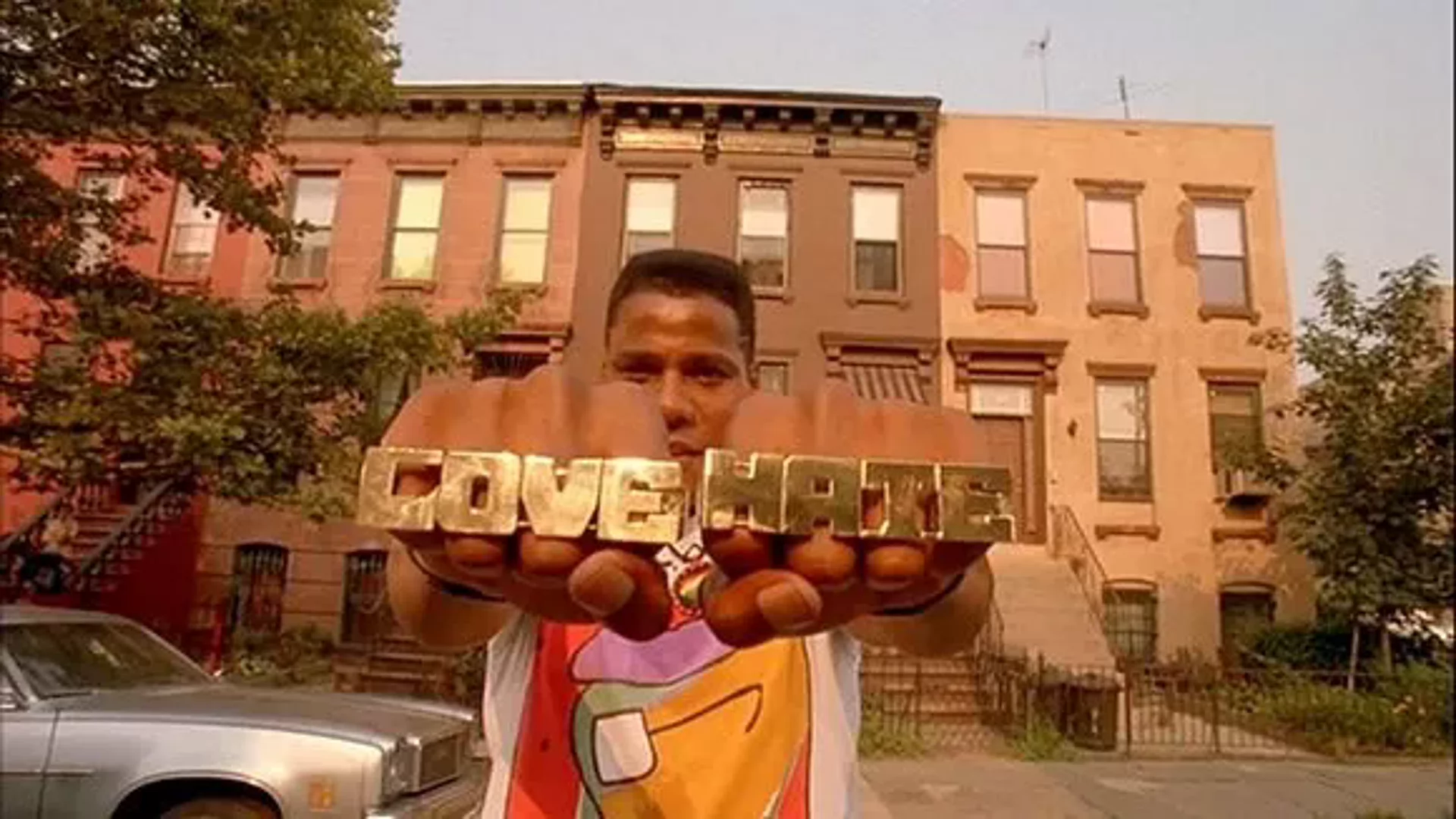
Do the Right Thing is one of Spike Lee’s most powerful films and addresses the lasting impact of racist ideology on African-American and larger U.S. communities, especially within communities where many people must live together. Lee battled with Paramount over the budget and script—issues that were not resolved. He finally ended up getting a deal with Universal Studios along with final cut approval—something he felt committed to having based on the marketing fiasco with School Daze. Do the Right Thing is Lee’s first union film—meaning, the first time he would use a union crew. With some wrangling, he secured a number of African-Americans into the International Brotherhood of Teamsters union, most who had been formerly excluded.
Do the RightThing, in many people’s minds, is the film that launched Lee into the company of great American filmmakers, as opposed to regulated to just African-American filmmakers. For 1989, it was the year’s most controversial film and received an Oscar nomination for Best Screenplay but not Best Picture. The slight Lee received by the Motion Picture Academy still reverberates in critical discussions of the film award industry.
Beyond the heft of the film itself, film scholar William Grant talks about the economic/production struggles Lee encountered to get it made. Grant writes: “The merchandising of DTRT, as with Lee’s two earlier films, was to be handled by his production company, Forty Acres and a Mule Filmworks. There had been companion volumes to the earlier films…and widespread marketing via T-shirts, sound tracks, buttons, letter jackets, and baseball caps. Lee’s comment, ‘Somebody wearing your T-shirt is a walking billboard…’.”
The film stars Samuel L. Jackson, John Turturro, Spike Lee, and introduces Rosie Perez. Do the Right Thing will be introduced by film scholar Dr. Miriam Petty of Northwestern University who appears as part of the inaugural Evalene Parsons Jackson Speakers series.

September 23 7:30 p.m.
Jungle Fever
Directed by Spike Lee
Introduced by Dr. Mikal Gaines (Massachusetts College of Pharmacy and Health Sciences)
Spike Lee’s Jungle Fever explores interracial coupling (specifically the black-white version of it), the devastation of drug use in Black communities, class status both within and outside of race, and gender roles. The film opens with a tribute to Yusef Hawkins, a young Black teen murdered in 1989.
On August 23, 1989, 16-year-old Hawkins went to look for a used car in the Bensonhurst area of Brooklyn, New York with three of his friends. A mob of about 30 youths approached them, most of them carrying bats. However, one was carrying a gun. This mob of mostly white Italian-Americans were angry because one of their girlfriends invited a Black boy to her eighteenth birthday party. Thinking Hawkins and his friends were there for the party, they beat them with bats and shot Hawkins dead. This real-lived tension undergirds the film.
In praise of Jungle Fever, film critic Alan Bell writes: “Ernest Dickerson’s photography is his best yet” (Los Angeles Sentinel). Film scholar Ed Guerrero argues that “Lee’s inclination for depicting the erotic has produced perhaps the most frank, seductive rendering of interracial, black-on-white sex on the Hollywood screen to date.” While others, like scholar William Lyne, suggest that Jungle Fever is an excellent example of a film that has been “portrayed as transgressive but end[s] up only reinforcing mainstream values.”
Jungle Fever stars Spike Lee, Wesley Snipes, Annabella Sciorra, Samuel L. Jackson, Ossie Davis, Ruby Dee, John Turturro, and introduces Halle Berry in her debut feature film role. Jungle Fever will be introduced by film scholar Dr. Mikail Gaines of the Massachusetts College of Pharmacy and Health Sciences-Boston, and he will lead the Q & A.

September 30 at 7:30 p.m.
Malcolm X
Directed by Spike Lee
Introduced by Dr. Charlene Regester (University of North Carolina-Chapel Hill)
Spike Lee’s Malcolm X comes out in 1992 with Warner Bros. The film is based on the 1964 book, The Autobiography of Malcolm X as told to Alex Haley, which was published one year before Malcolm X’s assassination. In the film, audiences see Malcolm X through various points of his varied, short life: as Malcolm Little, Malcolm X, and El- Hajj Malik El-Shabazz.
Getting the film to screen was no small feat since others had tried as well, having several different screenwriters over time. Film scholar Anna Everett writes about Lee’s negotiations with the work: “For Lee, courting controversy over Malcolm X was a necessary act of political and cultural intervention that turned on matters of credibility, authenticity, and even profitability.”
In an interview, Lee talks about the importance of Malcolm X and the need for everyone to see this biopic about him. He believed Malcolm X, his first PG film, could serve as an “important piece of American history and people, especially young kids, need to see this.” (Cineaste, 1993). So much so, Lee called for districts to release children from school to go see the film. Educator Samuel L. Banks writes in the Afro-American Red Star, the film “must portray Malcolm X as BECOMING, ASSIDUOUSLY BECOMING AND GROWING, if it is to have genuine validity, credibility and enduring appeal.”
Coming in just shy of 3 1/2 hours, Lee interprets Malcolm X’s motivations as grounded in his background, transitions, and his faith. Denzel Washington was nominated for an Oscar in his portrayal of Malcolm X. Alongside him, the film stars Angela Bassett, Al Freeman, Jr., Delroy Lindo, and Lee himself. Film historian Dr. Charlene Regester of the University of North Carolina will introduce the film and entertain questions afterwards.
October Screenings
Back to top
October 7, 7:30 p.m.
Crooklyn
Introduced by Dr. Nsenga Burton (Virginia State University) and Professor Dehanza Rogers (Emory University)
“Imagine sitting on the stoop of your Brooklyn brownstone, gossiping with the neighbors while kids play hop-scotch in the street and jump rope on the sidewalk. That's the urban community Spike Lee recreates in Crooklyn, a funny, high-energy movie about Carolyn and Woody Carmichael, and their five kids.” (Network Journal)
Crooklyn is a presumed semi-autobiographical tale of Shelton ‘Spike’ Lee’s family as told through a young girl, presumably his sister Joie Lee who co-wrote it with him along with their brother Cinque Lee. This is the second film in which Lee centers a female protagonist, the first being She’s Gotta Have It. Cinematographer Arthur Jaffa lenses this beautiful film that moves from the idyllic summer days of 1970s Brooklyn to the heat of the Black Virginia south.
Film scholar Mark D. Cunnigham believes the film highlights the beautiful diversity of New York City remarking: “all of these people shape Troy’s understanding of the world and provide her with a catalogue of rich, and often magical, experiences.” While cultural critic bell hooks challenged the gender roles articulated in this film, Crooklyn forces audiences to really consider the lives of Black girls. The film stars Alfre Woodard, Delroy Lindo, and introduces Zelda Harris as Troy, the central young girl in the film.
Virginia State University professor and mass communication department chair Nsenga Burton will introduce the film and participate in a talk back alongside Emory filmmaker and production head Professor Dehanza Rogers who teaches on Black girlhood.

October 14, 7:30 p.m.
Clockers
Directed by Spike Lee
Introduced by Dr. Paula Massood (Brooklyn College CUNY)
Clockers opens as the first film Spike Lee directed that he did not actually write. Adapted from Richard Price’s book Clockers, Lee taps cinematographer Malik Hassan Sayeed to re-imagine Black urban life set in the cross hairs of nonsensical violence. Using grainy film stock and differentiating dolly shots, Lee focuses on a group beyond the Black middle class. The film feels reminiscent to his 1983 thesis film, Joe’s BedstuyBarbershop: We Cut Heads but with a 1990s sensibility and ownership.
Clockers emerged at the beginning of what has been described as both a renaissance of Black filmmaking and a new Black exploitation period. This period was kicked off in 1991 with the releases of New Jack City and Boyz in the Hood. The success of these films encouraged Hollywood to produce several narratives of Black, urban, and poor communities with violence as the central figure. Clockers aims to counter this wave.
In her book, Black City Cinema, film professor Paula J. Massood talks about how this film “self-consciously examine[s] hood film conventions to explore the history of black migration.” She argues elsewhere, “Lee constructs a version of the contemporary African American city that concurrently acknowledges its history of migrations while avoiding the nihilism of many contemporary hood films set in similar locations. In the process he expands the boundaries of current African American cinema...” Clockers introduces actor Mekhi Phifer and stars Harvey Keitel, John Turturro, and Delroy Lindo.
Dr. Paula J. Massood, Dean of the School of Visual, Media and Performing Arts at Brooklyn College, will introduce the film and lead the Q & A afterwards.

October 21, 7:30 p.m.
Girl 6
Directed by Spike Lee
Introduced by Dr. Stephane Dunn (Morehouse College)
Print provided by Yale Film Archive.
Girl 6 is Spike Lee’s eighth commercial film and the third where he centers a woman as the main protagonist. Made in 1996, it is based on a play by African-American playwright Suzan-Lori Parks. It examines the phone sex business (as a parody of Hollywood) and one Black woman’s dreams against her negotiation of that industry. Essence gushes about Theresa Randle who stars as girl 6 saying, “Randle possesses the chameleonlike ability to be every woman you've ever known and one you've never met before.” Even cultural critic bell hooks, known for getting in Lee’s a** about his work, says: “I find Girl 6 to be a movie that not only challenges Hollywood but is a critical read on Hollywood.”
In a surrealist tone, the film attempts to deconstruct the lucrative but under-explored entertainment world of phone sex. Beautifully shot by DP Malik Hassan Sayeed, the film visually paints a psychology of the phone sex industry from the perspective of its beautiful workers. Prince writes and produces the entire soundtrack, making the “combination of the film's seductive content and old school Prince tunes, long known to have maintained a kinky edge… a perfect match” (Call & Post).
Beyond Randle as ‘Judy’ (Girl 6), the film stars Isaiah Washington, Jenifer Lewis, Debi Mezar, and Spike himself along with cameo appearances by filmmaker Quentin Tarantino, actors Ron Silver and Halle Berry, model Naomi Campbell, and singer Madonna.
Film scholar and maker Dr. Stephane Dunn, Morehouse College chair of the Cinema, Television, and Emerging Media Studies Department and author of Baad Bitches & Sassy Supermamas, will introduce the film and lead the Q & A.

October 28, 7:30 p.m.
4 Little Girls
Directed by Spike Lee
Introduced by Dr. Christine Acham (University of Hawai'i at Manoa)
4 Little Girls is Spike Lee’s first feature-length documentary. The film asks audiences to relive the horrific tragedy of the Sixteenth Street Baptist Church bombing in Birmingham, Alabama on a Sunday morning in 1963. It poignantly examines not only what happened but more importantly, the lives of the girls killed and the lives of those left behind. “Only a filmmaker so resourceful, so entirely confident in his practiced craft, could have made such a quilt out of patches of nightmare and nostalgia – of gospels, ghosts, and grief. And only Lee, having earned the trust of these people, could have persuaded them to talk to him” (New York Magazine).
Film scholar Delphine Letort writes about Lee’s documentary practice and his turn to documentary making saying: “The documentary’s explanatory approach to segregation provides valuable insight into the power dynamics of the period…” In addition, media professor Christine Acham believes the film “succeeds in shaking both Black and white viewers out of their contemporary apathy to U.S. racial history.” Both Acham and Letort discuss the ways in which the film tackles public versus private memory. They insist, as does Spike Lee, the need for us to remember.
“A day after the documentary was released, Birmingham police and the FBI formally reopened their investigation into the bombing due to unspecified ‘new information.’ Investigators say the timing was ‘coincidental’” (Rochester: About…Time Magazine). The history of the investigation of the bombing continues to be outlined on this website. 4 Little Girls was nominated for a ‘Best Documentary’ Oscar Award in 1997.
Professor Christine Acham, Chair of the School of Cinematic Arts at the University of Hawai'i at Manoa, will introduce the film and lead the Q & A afterwards.
November Screenings
Back to top
November 4, 7:30 p.m.
He Got Game
Directed by Spike Lee
Introduced by Dr. Samantha Sheppard (Cornell University)
If you’ve ever watched New York professional basketball or witnessed the 2026 championship Knicks play, you’ve seen Spike Lee live and in color. Lee is an avid basketball fan and has floor seats for all Knicks home games. He is also the director of many commercials that illuminate the sport like Chic H.I.S., the Continental Basketball Association, and those that kicked off the relationship between Michael Jordan and Nike. Lee’s love and knowledge of basketball make his 1998 film He Got Game aesthetically beautiful and contemplative.
A fascinating look into one of America’s favorite past times, the story deals with big-time college recruiting processes, the money and politics involved in sports, and one outstanding Black young man basketball player. The film is lensed by Malik Hassan Sayeed, the same cinematographer for Lee’s Clockers and Girl 6, and features real-life college and professional basketball personnel like coaches Lute Olsen of Arizona and Georgetown’s John Thompson and players Shaquille O’Neal, Bill Walton, and Reggie Miller. Says critic Roger Ebert, “Lee uses visual imagination to lift his material into the realms of hopes and dreams.” And connecting the art to commerce, film scholar Samantha Sheppard links He Got Game to Lee’s later digital work within NBA 2K16—Livin’ Da Dream—the digital and film all wrapped up and sold in one.
The main protagonist is real life former NBA player Ray Allen and as his father, Denzel Washington. It also features Rosario Dawson, Milla Jovovich, Zelda Harris, and Hill Harper.
The film will be introduced by film professor Samantha N. Sheppard of Cornell University whose new book The Basketball Film comes out in November.

November 11, 7:30 p.m.
Summer of Sam
Directed by Spike Lee
Introduced by Dr. Racquel Gates (Columbia University)
Released in 1999, Spike Lee’s Summer of Sam is based on the 1977 killing spree of David Berkowitz, known as the Son of Sam. It fuses that year’s heatwave, Bronx, New York energy, sex, and disco with the fear of a serial killer. It’s Lee’s first film not about Black communities.
Mike Imperioli (of The Sopranos fame), Victor Colicchio, and Lee wrote Summer of Sam. Actor and star Roger Guenveur Smith talks about the making of the film. “’Summer of Sam’ was shot almost entirely in the Country Club section of the Bronx where the first of the murders took place. ‘You could feel it among the people on the street who had actually lived through this summer and lost people to that man. On one level it's a movie; it's make-believe. But for some of the people in that community, it was a very real experience. It's difficult material and that's what makes for good drama.’” The parents of the young people killed by Berkowitz protested the making of the film with many feeling like the “portrayal of the Italian-American neighborhood focused on a sub-culture of the lowest form, teaming with criminal elements” (John Dabbene, Italian Voice).
Film philosophy scholar Dan Flory believes Summer of Sam functions thematically as a film noir about racial lynching. He writes, “Lee uses themes of confinement and determinism as in other noirs.” While film critic Keith Boseman calls the film “potent and occasionally electrifying. It is almost always riveting” (Hyde Park Citizen). Summer of Sam stars John Leguizamo, Adrien Brody, Mira Sorvino, and Roger Guenveur Smith.
Film scholar Racquel Gates of Columbia University will introduce the film and lead the Q & A.

November 18, 7:30 p.m.
Bamboozled
Directed by Spike Lee
Introduced by Dr. Alessandra Raengo (Georgia State University)
On a budget of ten million dollars and shot primarily on Mini-DV, Spike Lee wrote and directed the script for this funny and parodic examination of television targeting Black audiences. Lee wanted to experiment with the new technology and tapped Ellen Kuras to serve as the film’s DP (Kuras also shot 4 Little Girls and Summer of Sam). He notes, “…digital video was a good aesthetic choice because it’s a film about a television show…using Mini-DV suited this film perfectly because we had a lot to do on this shoot and we needed to move” (The St. Louis American).
Released in 2000, Bamboozled garnered a split reception of its meaning, significance and impact on filmmaking and Black representation. In her book Critical Race Theory and Bamboozled, film scholar Alessandra Raengo suggests that the film may be the blackest film ever made, writing: “This is the case visually but is also revealed in the way the film showcases how blackness has been built throughout the history of US media; visual, material, and consumer culture; and the history of the senses.” Adds film critic Duane Dudek, “Bamboozled paints a portrait of a corporate plantation where the slaves now have stock options” (Milwaukee Journal Sentinel). And as media scholar Beretta E. Smith-Shomade concludes, “Black progress comes at a price—the price to see the show or the price to be the show. Either way, it seems from Bamboozled, someone has to pay.”
Bamboozled stars Damon Wayans, Jada Pinkett Smith, Michael Rapaport, Yasiin Bey, Tommy Davidson, and Savion Glover. Professor Alessandra Raengo of Georgia State University will introduce the film and lead the Q & A.
December Screenings
Back to top
“Cornered by the DEA, convicted New York drug dealer Montgomery Brogan reevaluates his life in the 24 remaining hours before facing a seven-year jail term” (25th Hour logline). Based on David Benioff’s book of the same title, Spike Lee’s 25th Hour pays homage to the city of New York post 9/11. “Lee spans all of the five boroughs in this film. In his visits to Brooklyn, Queens, Staten Island, Manhattan and the Bronx, his camera focuses on symbols that glorify the richest city in the nation. Lady Liberty gets a shot from a Staten Island spot. The Brooklyn Bridge connects with Manhattan in a passing glance. Queens has its moments, too” (New York Amsterdam News). Beams of light shine where the twin towers stood in Manhattan and seeming chants and sounds of the Middle East create the introductory sonic.
The Afro-American Red Star calls it “both artsy and sophisticated, yet …also earthy and super realistic.” Made on a budget of five million, the domestic and worldwide earnings quadrupled its production costs. Lee and actor Edward Norton had talked about working together for several years before both received the project. Benioff had already written the script.
Entertainment journalist David McCullough writes that meditating “on innocence. ‘25thHour’ finds Spike reminiscing on some of his finest work” (Call & Post). Film scholar Mikal Gaines believes in the film, Lee offers “a compelling and informed critique of the ethics of punishment…[He] constructs...a blues that challenges punishment—essentially based on what is frequently a faulty dichotomy of offense and retribution—by drawing attention to its imprecision, its ineffectiveness as a means of understanding human suffering.”
25th Hour stars Edward Norton, Barry Pepper, Philip Seymour Hoffman, and Rosario Dawson. Film professor Mark Cunningham of Austin Community College will introduce the film and lead the Q & A.

December 9, 7:30 p.m.
BlackKklansman
Directed by Spike Lee
Introduced by Dr. Ellen C. Scott (University of California, Los Angeles)
BlacKkKlansman is a Spike Lee joint loosely based on Ron Stallworth’s memoir, Black Klansman, published in 2014. The story details the work life of Stallworth within the Colorado Springs Police Department in the 1970s. While there, as the department’s first Black detective, Stallworth attempts to infiltrate the local Ku Klux Klan.
The debates around the film and Lee’s perceived return to an earlier verve make for a compelling viewing experience. Longtime Village Voice cultural critic and author Greg Tate believes that “On a meta-level, Spike and BlacKkKlansman’s real-life heroic subject share something in common, they’re both spooks who not only spat inside the door but blew off its hinges in the process.”
However, scholar and writer Joshua Sperling notes that another filmmaker, Boots Riley, felt some type of way about the film. Apparently in a series of tweets, Riley accused Lee of producing “a politically compromised film at a time when the Black Liberation movement was focusing more and more on the systemic injustice of a militarized police force…the implication was that Lee’s renewed success was being conferred by the wrong people, achieved using the wrong means.”
BlacKkKlansman stars John David Washington, Adam Driver, and Laura Harrier. The film received six Academy Award nominations and was Spike Lee’s first nomination in the Best Director category. Lee wins his first competitive Oscar as co-writer of the film in the Best Adapted Screenplay category.
UCLA film scholar and special advisor on the L.A. Rebellion Dr. Ellen C. Scott will introduce the film and lead the Q & A.